

Wald Distribution#
Univariate, Continuous, Asymmetric, Non-Negative, Light-tailed
The Wald distribution, also known as the Inverse Gaussian distribution, is a continuous probability distribution characterized by its positive support and skewed shape. It is defined by two parameters: the mean (\(\mu\)) and the scale (\(\lambda\)). It is also used in survival analysis to model the time to an event.
The “Inverse” in the name can be misleading. The Wald distribution describes the time a particle subject to Brownian motion will drift to a certain point. Meanwhile, the Gaussian distribution gives the position of the motion at a fixed time. Only in that sense, the Wald is the “inverse” of the Gaussian.
Key properties and parameters#
Support |
\(x \in (0, \infty)\) |
Mean |
\(\mu\) |
Variance |
\(\mu^3 / \lambda\) |
Parameters:
\(\mu\) : Mean of the distribution.
\(\lambda\) : Scale parameter.
Alternative parametrizations:
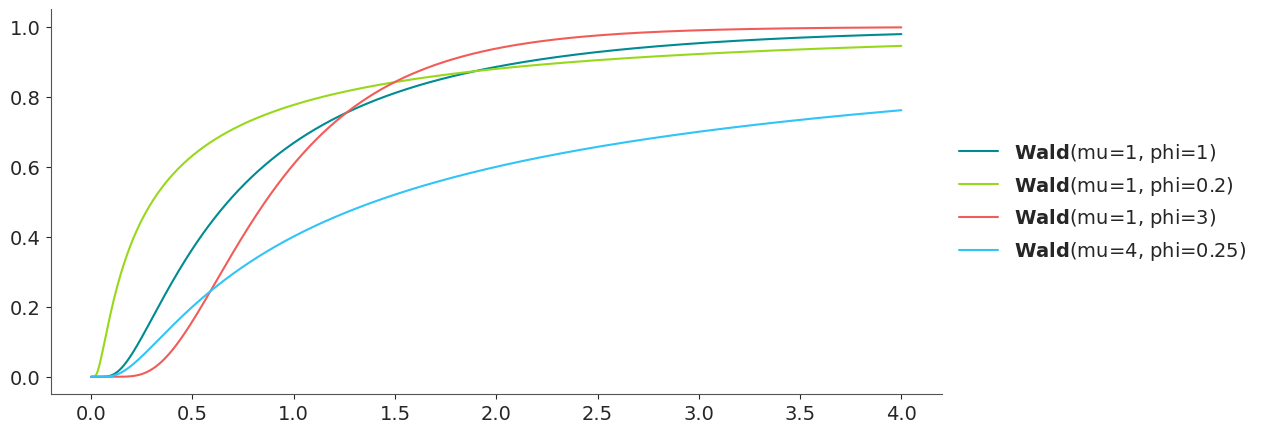
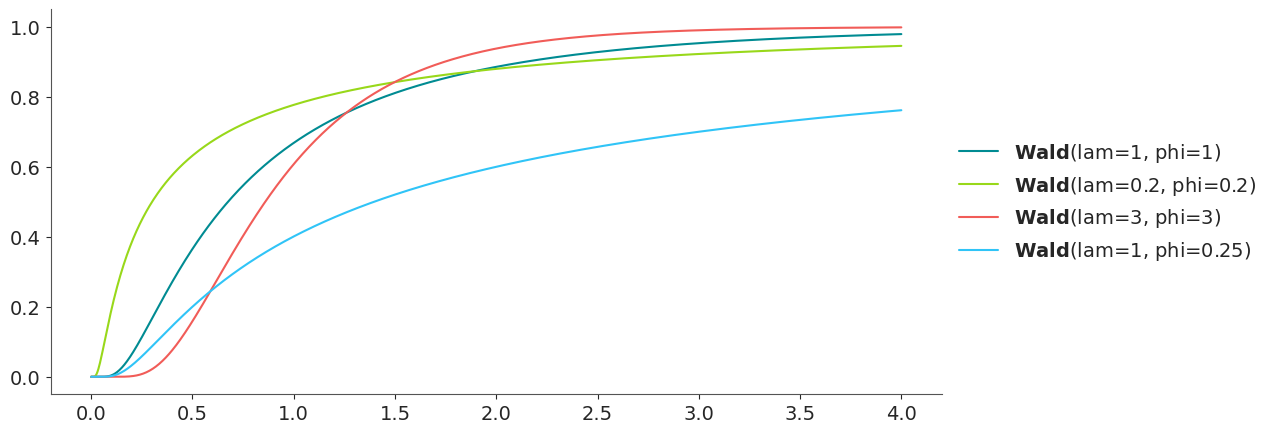
Wald distribution has 3 alternative parametrizations. In terms of \(\mu\) and \(\lambda\), \(\mu\) and \(\phi\), and \(\lambda\) and \(\phi\).
The link between the 3 alternatives is given by:
Probability Density Function (PDF)#
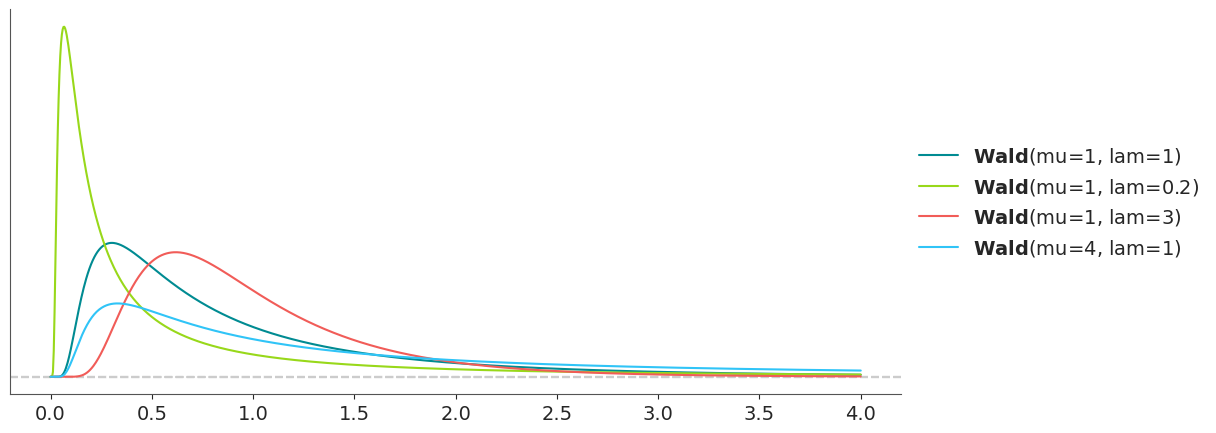
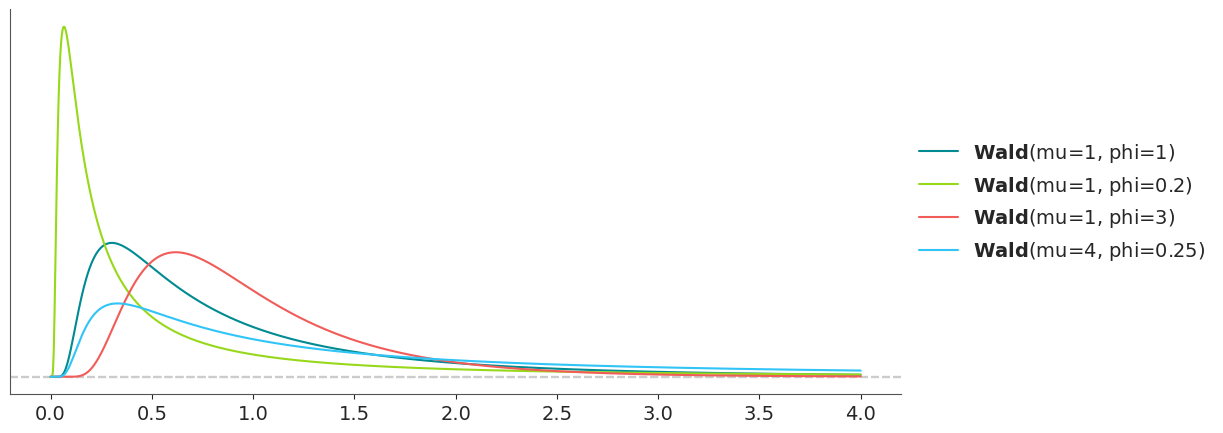
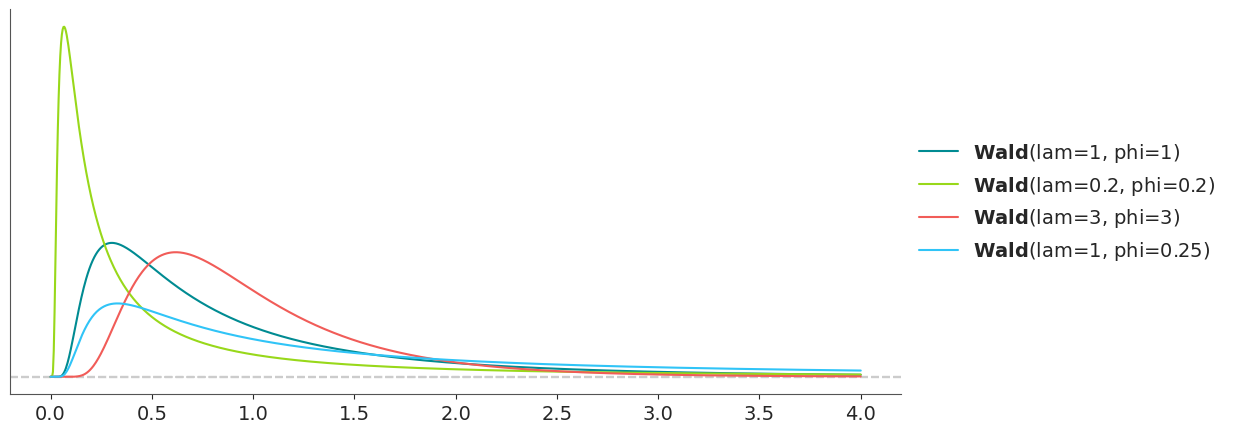
Cumulative Distribution Function (CDF)#
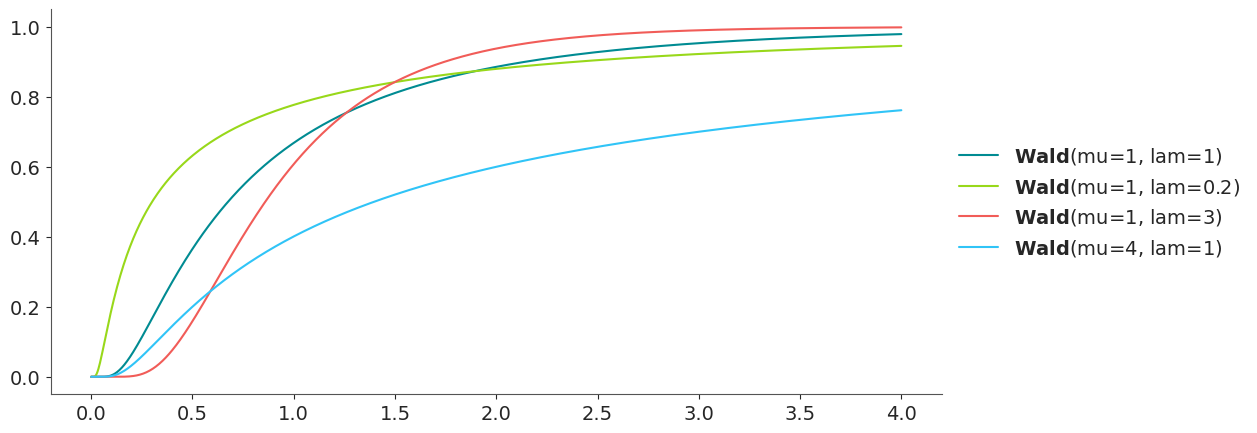
where \(\Phi\) is the standard normal cumulative distribution function.
See also
Related Distributions:
Inverse Gamma Distribution - When \(\mu \to \infty\) (zero drift velocity in Brownian motion), the Wald distribution converges to the inverse gamma distribution.
References#
Wikipedia - Wald Distribution