

Inverse Gamma Distribution#
Univariate, Continuous, Asymmetric, Non-Negative, Heavy-tailed
The Inverse Gamma distribution is a continuous probability distribution defined as the distribution of the reciprocal of a Gamma-distributed random variable. It is characterized by two parameters: the shape parameter \(\alpha\) and the scale parameter \(\beta\).
In mathematics, the Lévy distribution (a special case of the inverse gamma distribution with a shape parameter \(\alpha=0.5\)) describes the hitting time of a Wiener process, which is the probability distribution of the first time this stochastic process reaches a specific level.
In Bayesian statistics, the Inverse Gamma distribution often appears as the marginal posterior distribution for an unknown variance in a normal distribution when using an uninformative prior. It also serves as an analytically tractable conjugate prior when an informative prior is required.
Key properties and parameters#
Support |
\(x \in (0, \infty)\) |
Mean |
\(\dfrac{\beta}{\alpha-1}\) for \(\alpha > 1\) |
Variance |
\(\dfrac{\beta^2}{(\alpha-1)^2(\alpha - 2)}\) for \(\alpha > 2\) |
Parameters:
\(\alpha\) : (float) Shape parameter, \(\alpha > 0\).
\(\beta\) : (float) Scale parameter, \(\beta > 0\).
Alternative parametrization
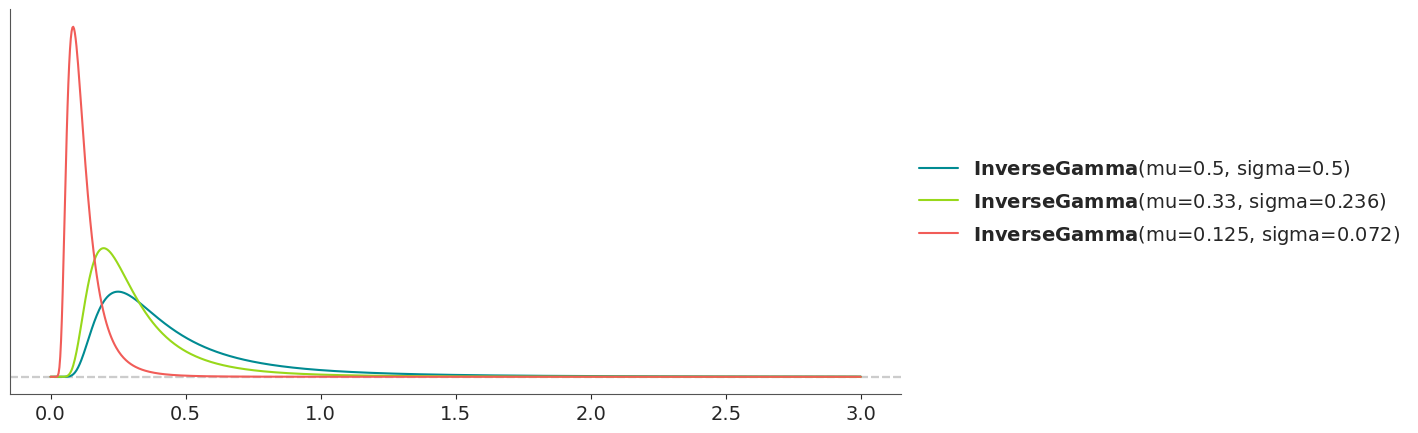
The Inverse Gamma distribution has 2 alternative parametrizations: in terms of the shape parameter \(\alpha\) and the scale parameter \(\beta\), or in terms of \(\mu\) (mean) and \(\sigma\) (standard deviation).
The link between the parameters is given by:
Probability Density Function (PDF)#
where \(\Gamma(\alpha)\) is the gamma function.

Cumulative Distribution Function (CDF)#
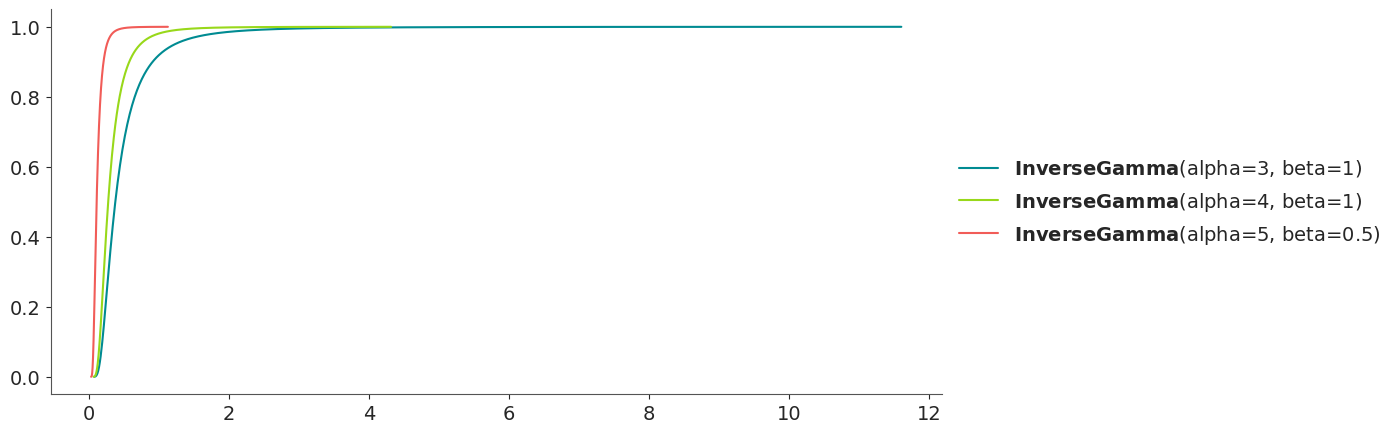
where \(\Gamma(\alpha, x)\) is the upper incomplete gamma function.

See also
Related Distributions:
Gamma Distribution - The Gamma distribution is the reciprocal of the Inverse Gamma distribution.