

Student’s t Distribution#
Univariate, Continuous, Symmetric, Unbounded, Heavy-tailed
The Student’s t distribution, also known as the t-distribution, is a continuous probability distribution that resembles the normal distribution but with heavier tails. It is characterized by its bell-shaped curve, symmetric around the mean, and can defined by three parameters: the degrees of freedom (\(\nu\)), the location parameter (\(\mu\)), and the scale parameter (\(\sigma\)). The smaller the value of (\(\nu\)), the heavier the tails of the distribution.
It is often used in Bayesian analysis particulary as a robust alternative to the Normal due to the possibility of having heavier tails.
Key properties and parameters#
Support |
\(x \in \mathbb{R}\) |
Mean |
\(\mu\) for \(\nu > 1\), otherwise undefined |
Variance |
\(\frac{\nu}{\nu-2}\) for \(\nu > 2\), \(\infty\) for \(1 < \nu \le 2\), otherwise undefined |
Parameters:
\(\nu\) : (float) Degrees of freedom, \(\nu > 0\).
\(\mu\) : (float) Location parameter.
\(\sigma\) : (float) Scale parameter, \(\sigma > 0\).
Alternative parametrization
The Student’s t distribution has two alternative parameterizations. In terms of \(\nu\), \(\mu\), and \(\sigma\), or in terms of \(\nu\), \(\mu\) and \(\lambda\).
The link between the 2 alternatives is given by:
where \(\sigma\) is the standard deviation as \(\nu\) increases, and \(\lambda\) is the precision as \(\nu\) increases.
Probability Density Function (PDF)#
where \(\Gamma\) is the gamma function.
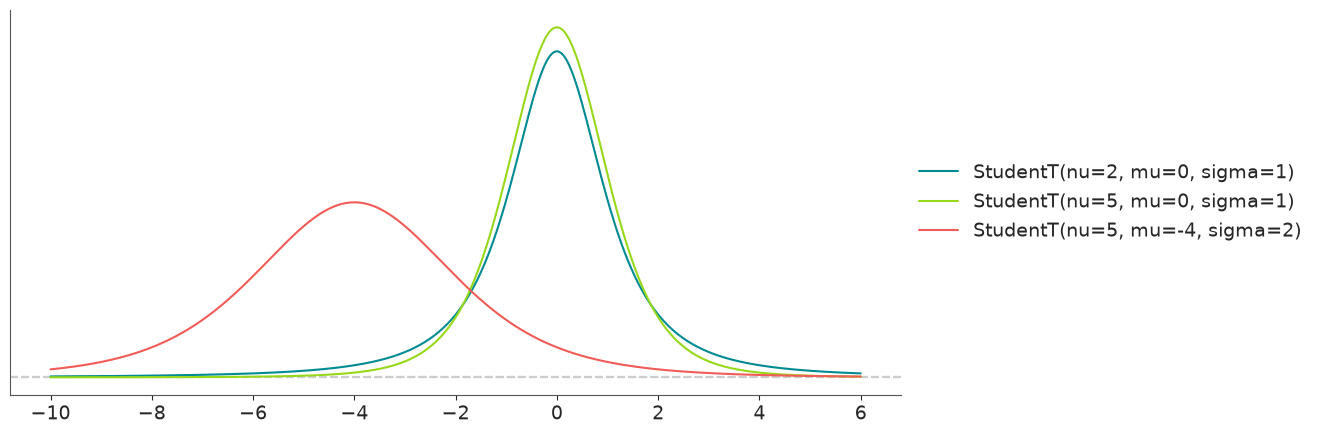
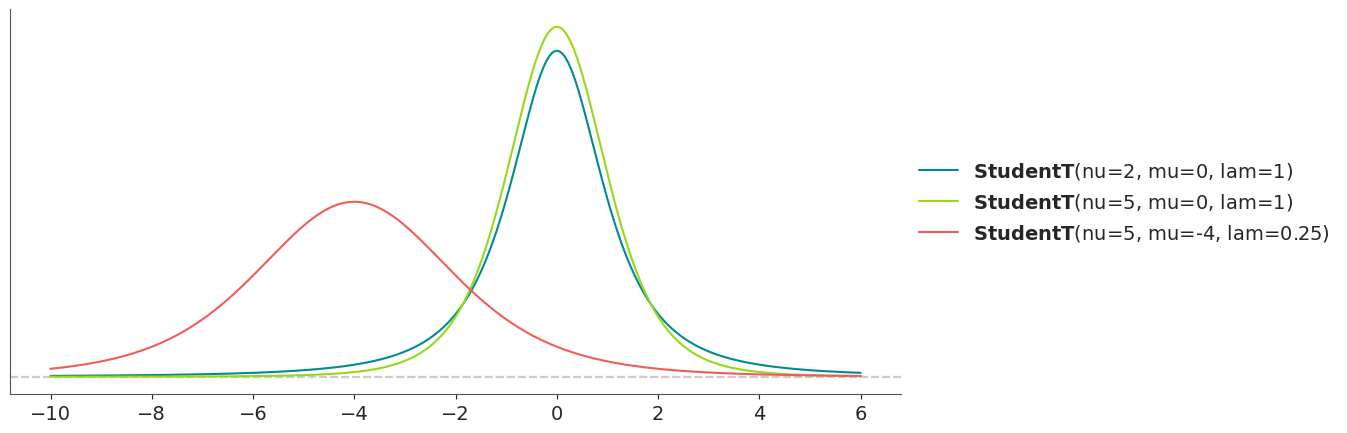
Cumulative Distribution Function (CDF)#
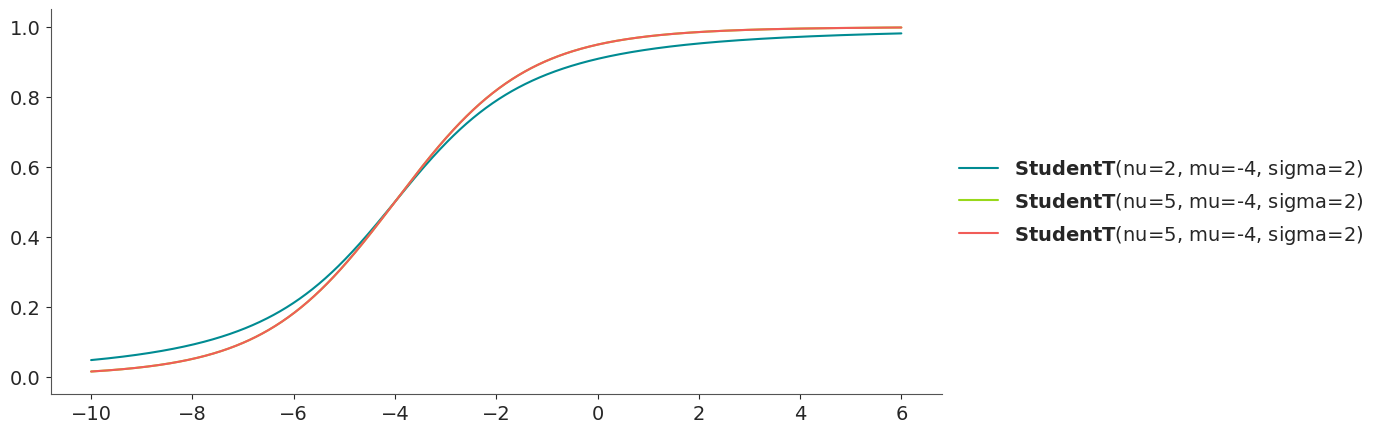
where \(I_x(a, b)\) denotes the regularized incomplete beta function.

See also
Common Alternatives:
Skewed Student’s t - Extends the Student’s t-distribution by introducing a skewness parameter, allowing for the modeling of data that is not symmetrically distributed.
Half-Student’s t - Considers only the positive values of the Student’s t-distribution.
Normal - When \(\nu \to \infty\), the t-distribution converges to the normal distribution.
Cauchy - The Cauchy distribution is a special case of the Student’s t-distribution with \(\nu=1\).
References#
Wikipedia. Student’s t-distribution