

Half-Student’s t Distribution#
Univariate, Continuous, Non-Negative, Asymmetric, Heavy-tailed
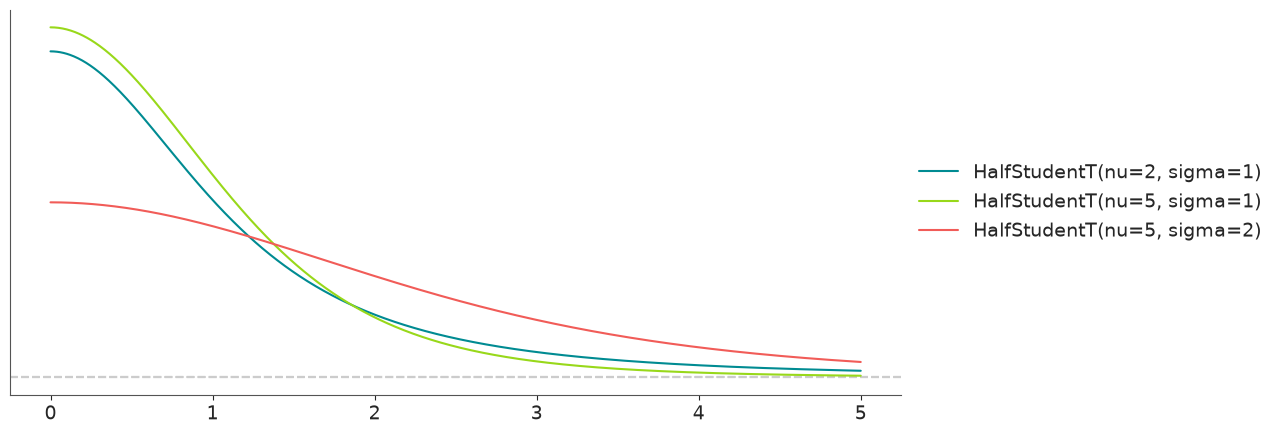
The Half-Student’s t distribution, also known as the half-t distribution, is a continuous probability distribution that is derived from the Student’s t distribution but is restricted to only positive values. It is characterized by two parameters: the degrees of freedom (\(\nu\)) and the scale parameter (\(\sigma\)), which determines the width of the distribution. The smaller the value of \(\nu\), the heavier the tails of the distribution.
In Bayesian statistics, the Half-Student’s t distribution is often used as a prior for scale parameters.
Key properties and parameters#
Support |
\(x \in [0, \infty)\) |
Mean |
\[2\sigma\sqrt{\frac{\nu}{\pi}}\
\frac{\Gamma\left(\frac{\nu+1}{2}\right)}
{\Gamma\left(\frac{\nu}{2}\right)(\nu-1)}\, \text{for } \nu > 2\]
|
Variance |
\[\sigma^2\left(\frac{\nu}{\nu - 2}-\
\frac{4\nu}{\pi(\nu-1)^2}\left(\frac{\Gamma\left(\frac{\nu+1}{2}\right)}
{\Gamma\left(\frac{\nu}{2}\right)}\right)^2\right) \text{for } \nu > 2\, \infty\
\text{for } 1 < \nu \le 2\, \text{otherwise undefined}\]
|
Parameters:
\(\nu\) : (float) Degrees of freedom.
\(\sigma\) : (float) Scale parameter.
\(\lambda\) : (float) Precision parameter.
Alternative parametrization
The Half-Student’s t distribution has 2 alternative parameterizations. In terms of \(\nu\) and \(\sigma\), or in terms of \(\nu\) and \(\lambda\).
The link between the 2 alternatives is given by:
where \(\sigma\) is the standard deviation as \(\nu\) increases, and \(\lambda\) is the precision as \(\nu\) increases.
Probability Density Function (PDF)#
where \(\Gamma\) is the gamma function.

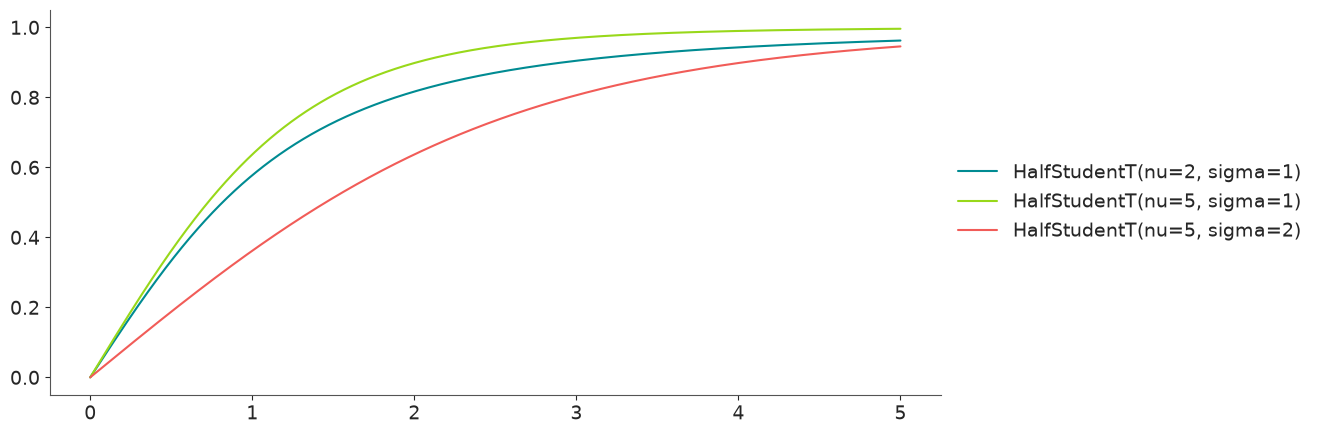
Cumulative Distribution Function (CDF)#
where \(I_x(a, b)\) denotes the regularized incomplete beta function.

See also
Common Alternatives:
Half-Cauchy - The Half-Cauchy distribution is a special case of the Half-Student’s t distribution with \(\nu = 1\).
Half-Normal - As \(\nu \to \infty\), the Half-Student’s t distribution approaches the Half-Normal distribution.
Related Distributions:
Student’s t - The Student’s t distribution is the parent distribution from which the Half-Student’s t distribution is derived.