

Log-Normal Distribution#
Univariate, Continuous, Asymmetric, Non-Negative, Heavy-tailed
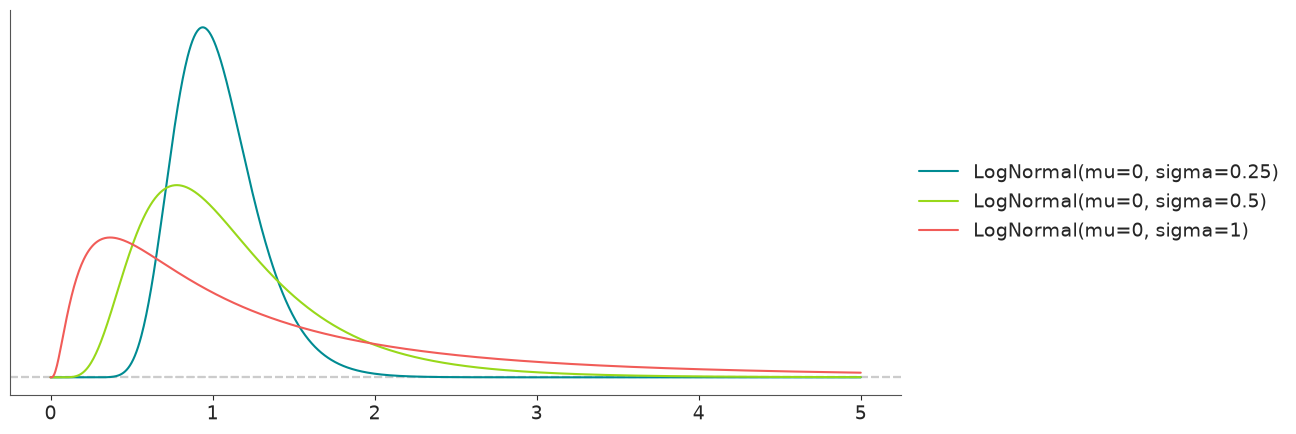
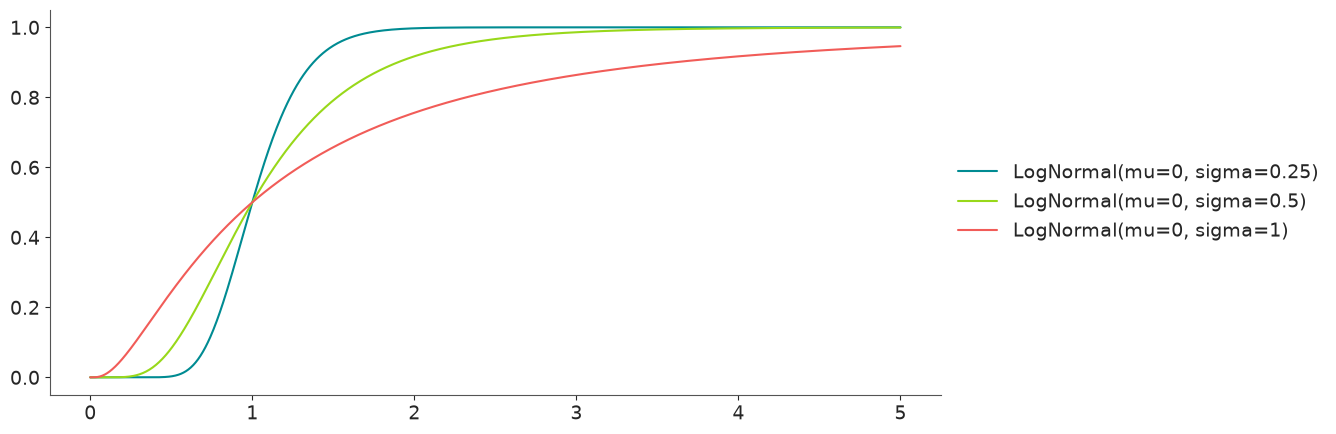
The log-normal distribution is a continuous probability distribution of a random variable whose logarithm is normally distributed. Thus, if a random variable \(X\) follows a log-normal distribution, then \( Y = \log(X)\) is normally distributed. It has a right-skewed shape and is defined for positive values of \(x\). It is is characterized by two parameters: \(\mu\) and \(\sigma\), which are the mean and standard deviation of the log-transformed variable, respectively, not the original variable.
The log-normal distribution is commonly used to model variables that are positive and result from the product of many small independent factors (instead of the sum of factors, as in the normal distribution). This property makes it a widespread choice for modeling quantities in many fields of knowledge, including biology, engineering, medicine, finance and others. For example, In hydrology, the log-normal distribution is used to model the distribution of annual maximum rainfall, river discharge, and other hydrological variables.
Key properties and parameters#
Support |
\(x \in (0, \infty)\) |
Mean |
\(e^{\mu + \frac{\sigma^2}{2}}\) |
Variance |
\((e^{\sigma^2} - 1)e^{2\mu + \sigma^2}\) |
Parameters:
\(\mu\) : (float) Location parameter.
\(\sigma\) : (float) Scale parameter, \(\sigma > 0\).
Probability Density Function (PDF)#
Cumulative Distribution Function (CDF)#
See also
Common Alternatives:
Normal - The log-normal distribution is directly related to the normal distribution since if a variable is log-normally distributed, its logarithm follows a normal distribution. This relationship is crucial for understanding the log-normal’s properties and applications.
Related Distributions:
Exponential - It’s a simpler model for positive, skewed data but lacks the flexibility of the log-normal distribution in modeling a wide range of shapes.
Gamma - Used for modeling positively skewed data, similar to the log-normal distribution, but with different skewness and kurtosis properties.
Pareto - Also models positive, skewed data, focusing on the “long tail” of distribution which is useful in economics and finance for modeling wealth distribution or significant rare events.
References#
Wikipedia - Log-normal distribution