Prior predictive assistant#
Now we will see a very experimental tool called “prior predictive assistant” (ppa for short). Suppose we have a model and we want to explore the prior predictive distribution and if possible refine the priors in our model. A common scenario in practice is that after some thinking we are able to define a model, but our priors are still too wide, as we are underusing our prior knowledge.
import preliz as pz
import numpy as np
import pandas as pd
pz.style.library["preliz-doc"]["figure.dpi"] = 100
pz.style.library["preliz-doc"]["figure.figsize"] = (10, 4)
pz.style.use("preliz-doc")
Let’s assume a Normal model with an unknown mean and standard deviation, here a and b represent our priors and y the
likelihood.
np.random.seed(1237)

def a_preliz_model():
    a = pz.Normal(0, 10).rvs()
    b = pz.HalfNormal(10).rvs()
    y = pz.Normal(a, b).rvs(100)
    return a, b, y
%matplotlib widget
pz.ppa(a_preliz_model)
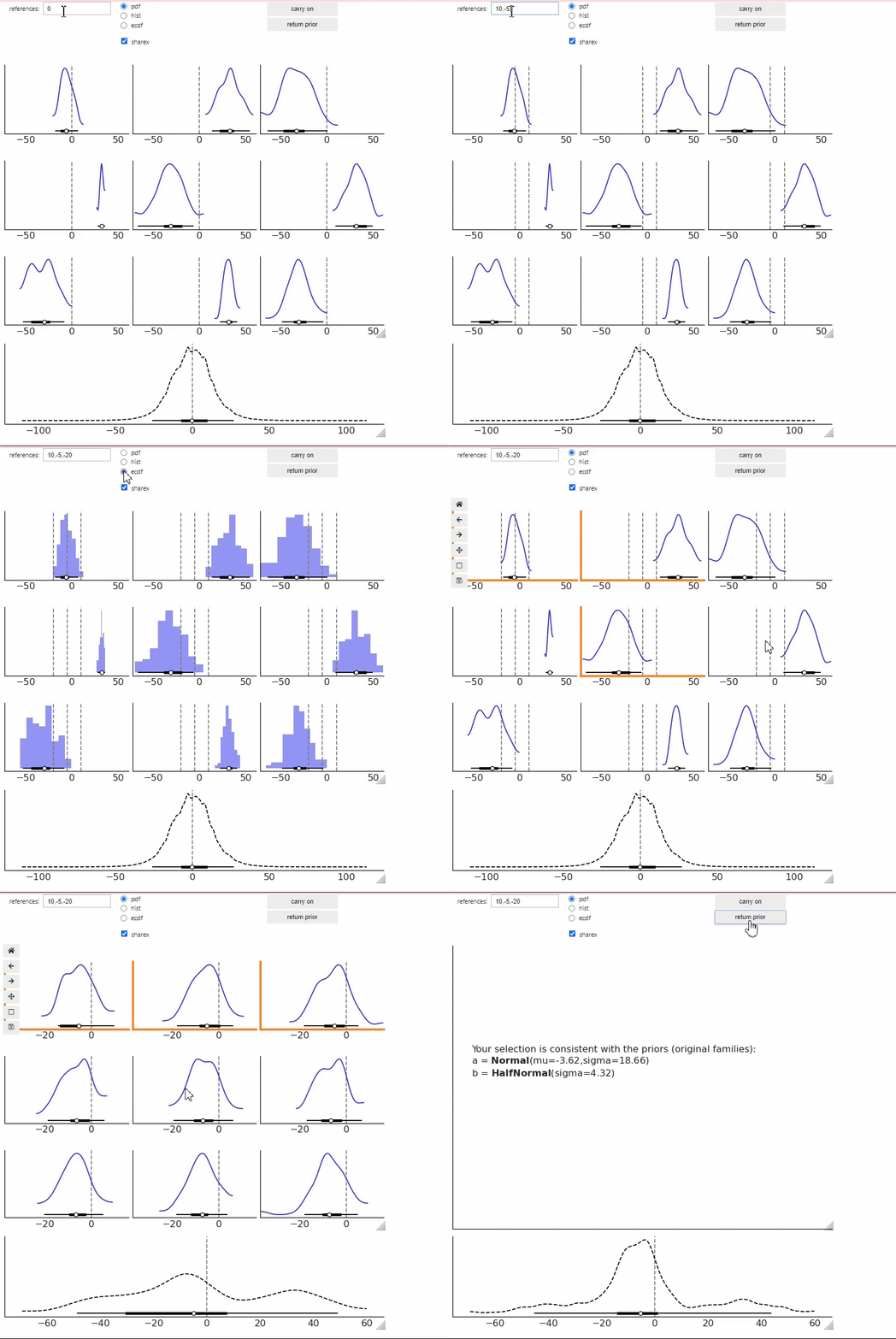
The ppa function will take the function a_preliz_model and generate 2000 samples from the prior (a, b) and
prior_predictive distribution y. Then it will automatically select 9 samples from the prior_predictive distribution (
the blue distributions in the 3x3 grid). At the bottom (black dashed line) we have a plot of the 2000 samples
altogether.
Then, from the 3x3 grid, we can select one or more samples that match our domain knowledge. If we click on
the carry on button we will get a new set of samples from the prior predictive distribution. The bottom panel will
automatically update to reflect all previously selected samples. Once we have selected a few distributions we click on
the return prior button to get a prior that agrees with the selected predictive distributions.
Four important aspects when trying ppa is that:
We want to select distributions based on prior information and NOT based on the observed data we want to fit.
The more distributions we select the more accurate the results should be.
The returned prior is just a suggestion, to be sure the suggestion is useful you may want to try
ppaa couple of times and see how variable results are and do further tests like usingpredictive_explorerThis is experimental, both in the sense the code may have bugs and in the sense that the methodology could be dubious, or at least unrefined
A few more details about what is going on under the hood
By default, the first set of samples is selected at random but tries to return a diverse subset. At any point, you can
click on the carry on button. Even when we have not selected any distribution, in such a case we will get a new set of
samples and the bottom panel will not be updated, simply because the selected set of distributions remains the same.
After we have selected at least one sample, the following samples that are shown will be chosen to be similar to the
previously selected ones. But if you keep clicking on the carry on button, eventually ppa is going to return random
samples again. Every time we select a sample, ppa will try to select a few more for us, we are not able to directly
see them but they are going to affect the bottom panel, so we can monitor that ppa did not select something too far or
different from what we want.
Alternatively to the random initialization, we can provide information to ppa about our prior knowledge by passing
the init argument. If that’s the case, then ppa will first show 9 samples to be as close as possible to what is
specified by init. Currently, we have two options, pass a PreliZ distribution or a 2-tuple with the first element
representing the mean and the second, the standard deviation. There is also a boundaries argument, that we can use to
specify hard lower and/or upper boundaries. Samples with values outside these boundaries will not be available for
selection, either by the user or ppa. Essentially, those samples will be discarded.
ppa returns two sets of priors:
One that is restricted to return a prior on the same family as specified in the PreliZ model, in this example the prior for
awill always beNormaland the prior forb,HalfNormal.One that can select new families. We are currently exploring how to do this properly and what limitations this has, for example, it is expected that we will need to select more distributions to trust these results that the ones with the original families. Also we may want to have more control over which other families we want, like explicitly define them or add some restrictions like “positive distributions” only.
If you are unable to run this notebook, you can get a glimpse of ppa from this gif: