

Triangular Distribution#
Univariate, Continuous, Bounded, Light-tailed
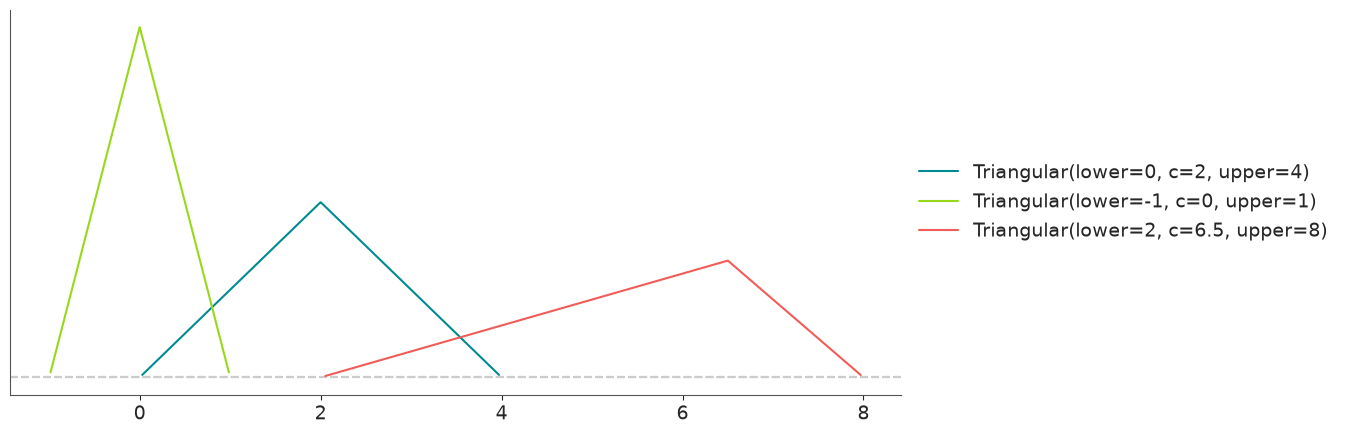
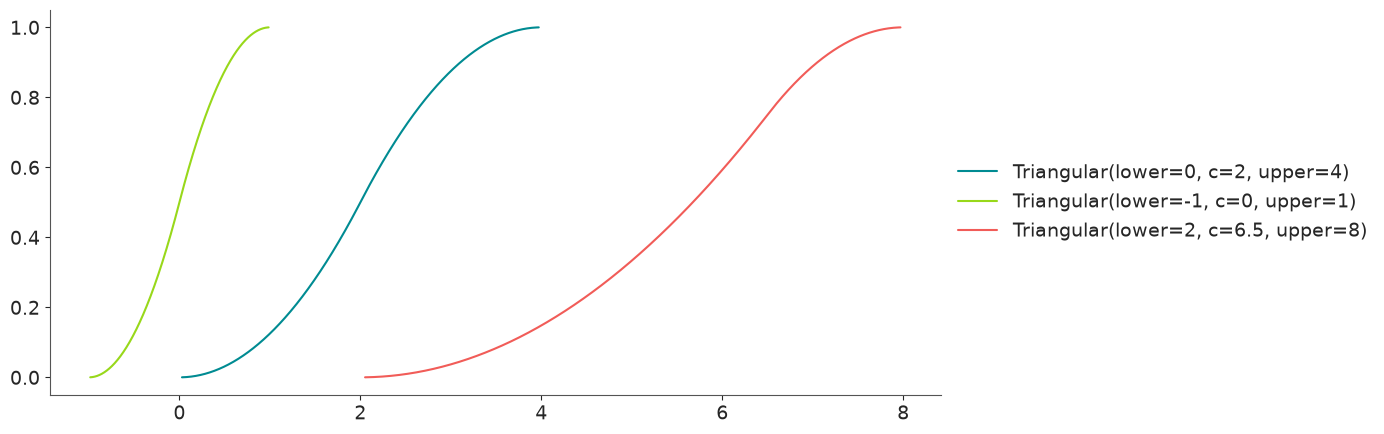
The Triangular distribution is a continuous probability distribution with a triangular shape. It is defined by three parameters: the lower bound \(lower\), the mode \(c\), and the upper bound \(upper\). Where \(lower \leq c \leq upper\).
The Triangular distribution is often called a “lack of knowledge” distribution because it can be used when there is no prior knowledge about the distribution of the random variable other than the minimum, maximum, and most likely values. It is often used in business simulations and decision-making, project management, and audio dithering.
Key properties and parameters#
Support |
\(x \in [lower, upper]\) |
Mean |
\(\dfrac{lower + upper + c}{3}\) |
Variance |
\(\dfrac{upper^2 + lower^2 +c^2 - lower*upper - lower*c - upper*c}{18}\) |
Parameters:
\(lower\) : (float) Lower bound of the distribution.
\(c\) : (float) Mode of the distribution, \(lower \leq c \leq upper\).
\(upper\) : (float) Upper bound of the distribution.
Probability Density Function (PDF)#
Cumulative Distribution Function (CDF)#
See also
Related Distributions:
Uniform Distribution - A distribution with constant probability that is also used when there is limited prior knowledge about the distribution of the random variable: in this case, only the \(lower\) and \(upper\) bounds are known.
References#
Wikipedia. Triangular distribution.