

Scaled Inverse Chi-Squared Distribution#
Univariate, Continuous, Non-Negative
The Scaled Inverse chi-squared (Scale-Inv-\(\chi^2\)) is a continuous probability distribution characterized by two parameters, \(\nu\), usually called degrees of freedom, and \(\tau^2\), a scale parameter.
The Scaled Inverse chi-squared distribution is mainly used in Bayesian inference as a conjugate prior for variance parameters in normal models, particularly in Bayesian regression, hierarchical models, and time-series analysis.
Key properties and parameters#
Support |
\(x \in [0, \infty)\) |
Mean |
\(\frac{\nu \tau^2}{\nu - 2}\) for \(\nu > 2\), else \(\infty\) |
Variance |
\(\frac{2 \nu^2 \tau^4}{(\nu - 2)^2 (\nu - 4)}\) for \(\nu > 4\), else \(\infty\) |
Parameters:
\(\nu\) : (float) Degrees of freedom, \(\nu > 0\).
\(\tau^2\) : (float) Scale parameter, \(\tau^2 > 0\).
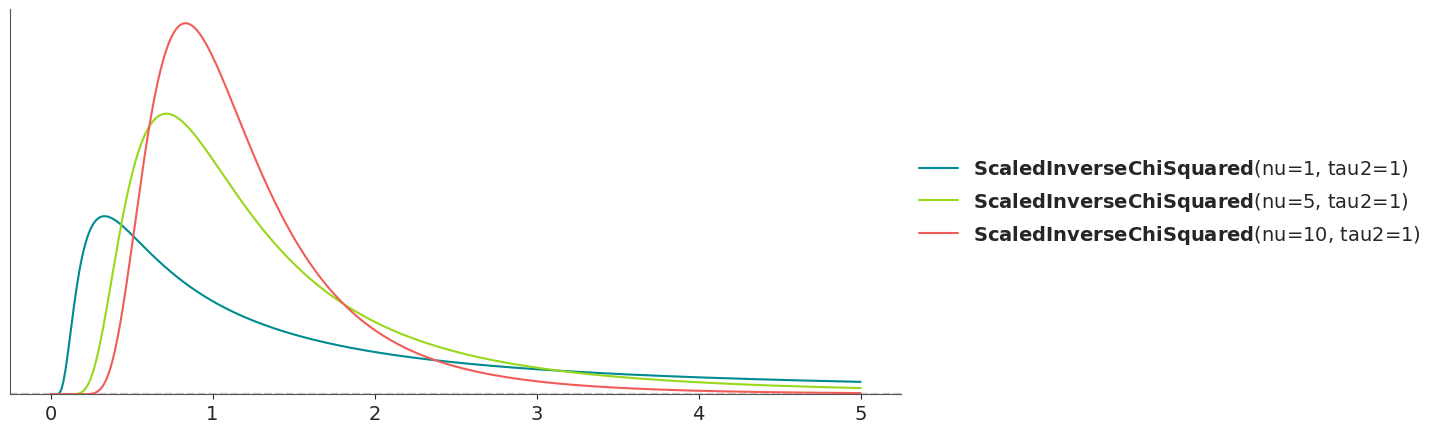
Probability Density Function (PDF)#
where \(\Gamma(\nu)\) is the gamma function.
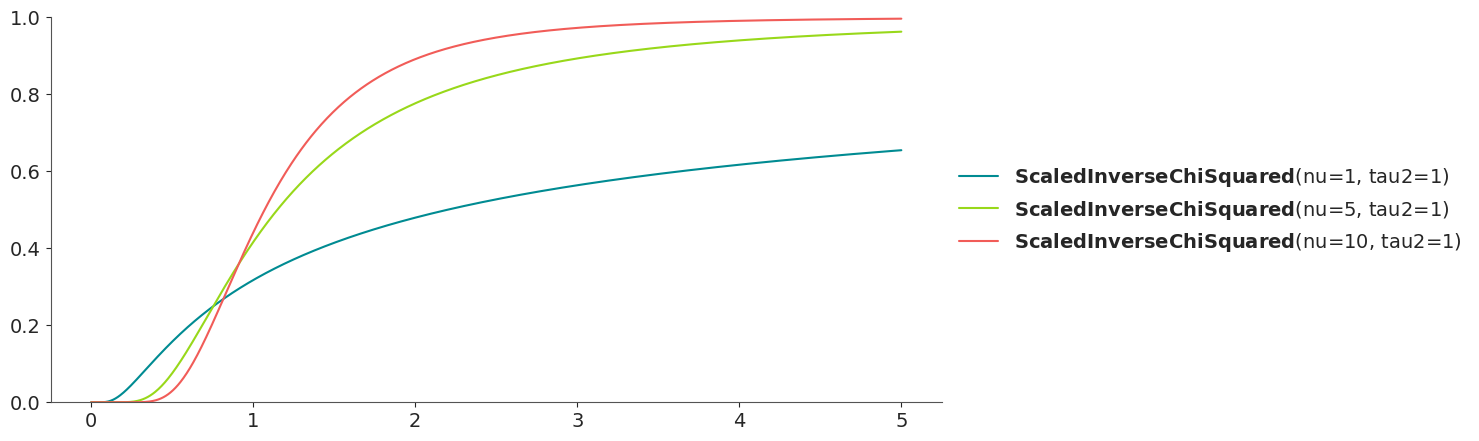
Cumulative Distribution Function (CDF)#
where \(\Gamma(\nu, x)\) is the incomplete gamma function.
See also
Related Distributions:
Chi-Squared - The Inverse Chi-Squared distribution can be thought of as the reciprocal of a scaled Chi-Squared random variable.
Gamma - the Inverse Chi-Squared distribution can be seen as the reciprocal of a Gamma-distributed variable with specific parameters.