

Rice Distribution#
Univariate, Continuous, Asymmetric, Non-Negative, Light-tailed
The Rice distribution is the probability distribution of the magnitude of a circularly-symmetric bivariate normal random variable. It’s characterized by two parameters: \(v\), which represents the non-centrality parameter, and \(\sigma\), the scale parameter.
The Rice distribution is often used in signal processing, particularly in the analysis of noisy signals, such as radar and communication systems.
Key properties and parameters#
Support |
\(x \in (0, \infty)\) |
Mean |
\(\sigma \sqrt{\pi /2} L_{1/2}(-\nu^2 / 2\sigma^2)\) |
Variance |
\(2\sigma^2 + \nu^2 - \frac{\pi \sigma^2}{2}\) \(L_{1/2}^2\left(\frac{-\nu^2}{2\sigma^2}\right)\) |
Parameters:
\(v\) : (float) Non-centrality parameter, \(v \geq 0\).
\(\sigma\) : (float) Scale parameter, \(\sigma > 0\).
Alternative parametrization
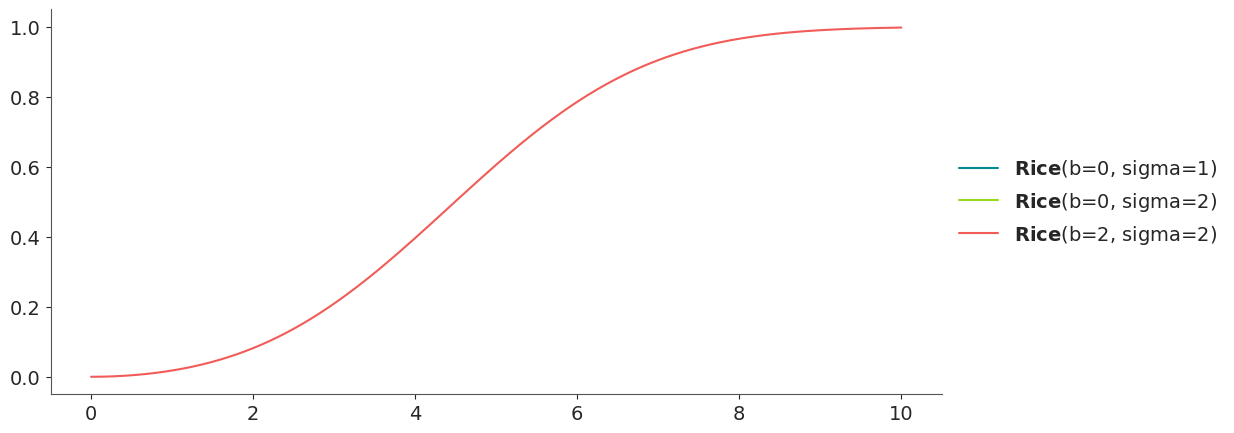
The Rice distribution has two alternative parameterizations: in terms of \(v\) and \(\sigma\), or in terms of \(b\) and \(\sigma\). The relationship between the two is given by:
Probability Density Function (PDF)#
where \(I_0\) is the modified Bessel function of the first kind.
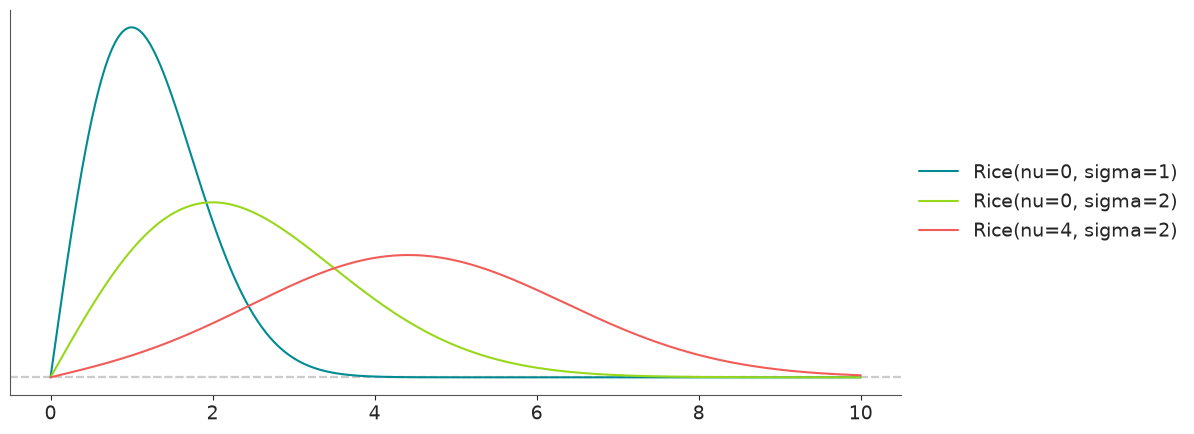
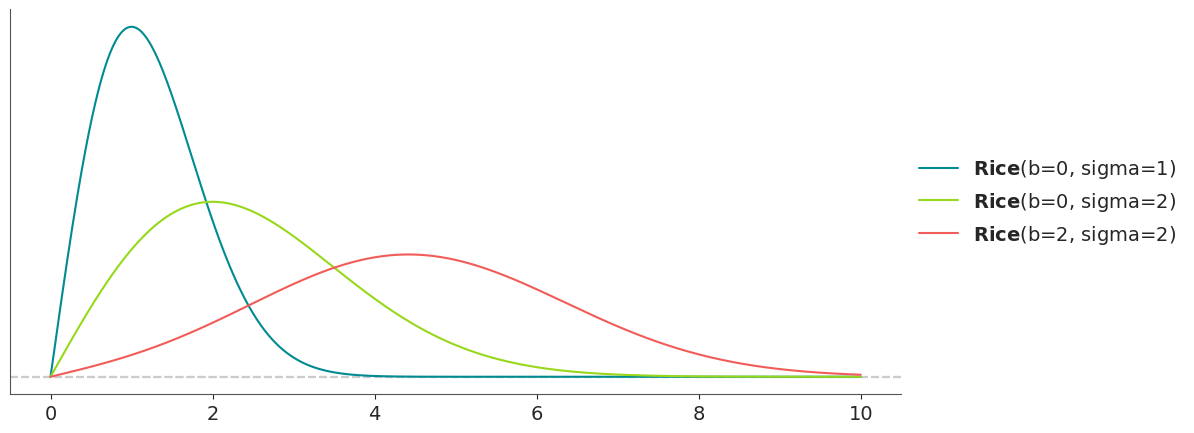
Cumulative Distribution Function (CDF)#
where \(Q_1\) is the Marcum Q-function.
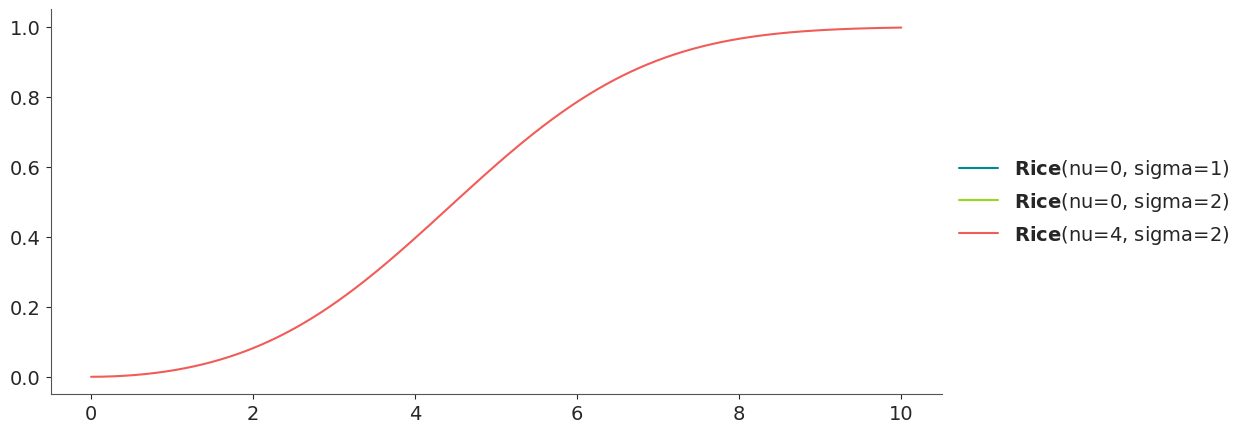
See also
Related Distributions:
Normal - The Rice distribution is the magnitude of a bivariate normal distribution.
References#
Wikipedia - Rice distribution