

Poisson Distribution#
Univariate, Discrete, Non-Negative
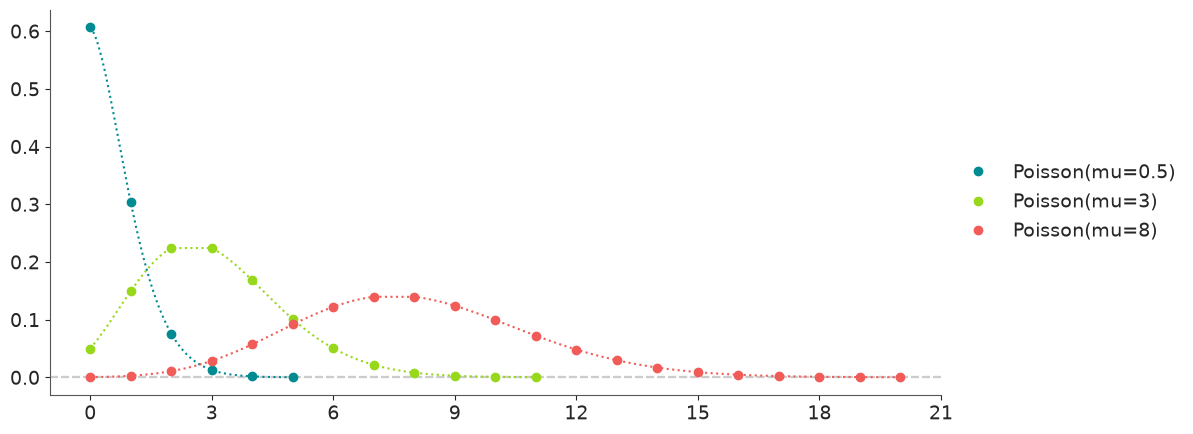
The Poisson distribution is a discrete probability distribution that expresses the probability of a given number of events occurring in a fixed interval of time (or space) if these events occur with a known constant mean rate and independently of the time since the last event.
Key properties and parameters#
Support |
\(x \in \mathbb{N}_0\) |
Mean |
\(\mu\) |
Variance |
\(\mu\) |
Parameters:
\(\mu\) : (float) The mean rate of events, \(\mu > 0\).
Probability Density Function (PDF)#
Cumulative Distribution Function (CDF)#
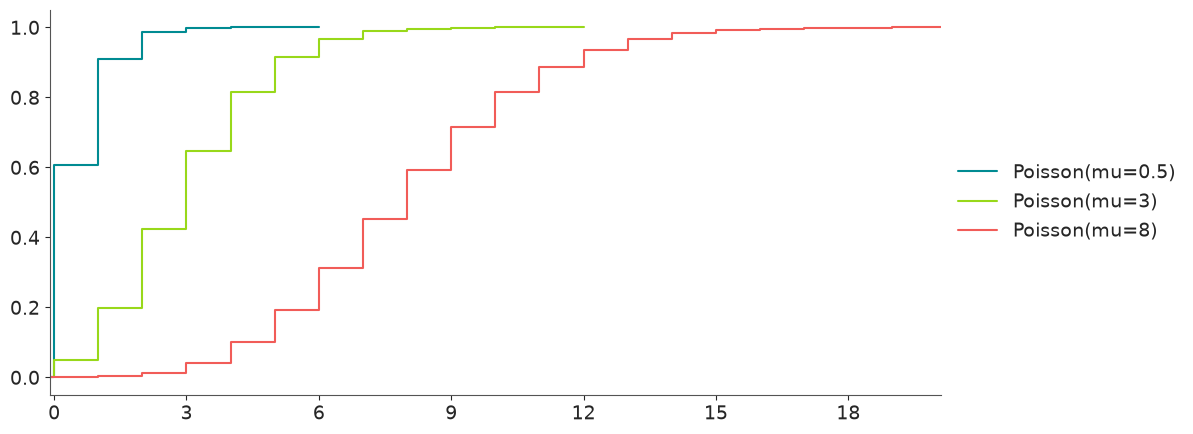
where \(\Gamma(x + 1, \mu)\) is the upper incomplete gamma function.
See also
Common Alternatives:
NegativeBinomial - The Negative Binomial is often used as an alternative the Poisson when the variance is greater than the mean (overdispersed data).
ZeroInflatedPoisson - The Zero-Inflated Poisson is used when there is an excess of zero counts in the data.
HurdlePoisson - The Hurdle Poisson is used when there is an excess of zero counts in the data.
Related Distributions:
Binomial - The Poisson distribution can be derived as a limiting case to the binomial distribution as the number of trials goes to infinity and the expected number of successes remains fixed. See law of rare events.
Normal - For sufficiently large values of \(\mu\), the normal distribution with mean \(\mu\) and standard deviation \sqrt{\mu} can be a good approximation to the Poisson.