

Multivariate Normal Distribution#
Multivariate, Continuous, Symmetric, Unbounded
The multivariate normal distribution, also known as the multivariate Gaussian distribution, is a generalization of the univariate normal distribution to multiple dimensions. A random vector is said to follow a \(k\)-dimensional multivariate normal distribution if every linear combination of its \(k\) components follows a univariate normal distribution.
The multivariate normal distribution is often used to describe the joint distribution of a set of correlated random variables.
In Bayesian modeling, a Gaussian process is a generalization of the multivariate normal distribution to infinite dimensions, and it is used as a prior distribution over functions.
Key properties and parameters#
Support |
\(x \in \mathbb{R}^k\) |
Mean |
\(\mu\) |
Variance |
\(T^{-1}\) |
Parameters:
\(\mu\) : (array of floats) Mean vector of length \(k\).
\(\Sigma\) : (array of floats) Covariance matrix of shape \(k \times k\).
\(T\) : (array of floats) Precision matrix, the inverse of the covariance matrix.
Alternative parameterization:
The MvNormal has 2 alternative parameterizations. In terms of the mean and the covariance matrix, or in terms of the mean and the precision matrix.
The link between the 2 alternatives is given by:
Probability Density Function (PDF)#
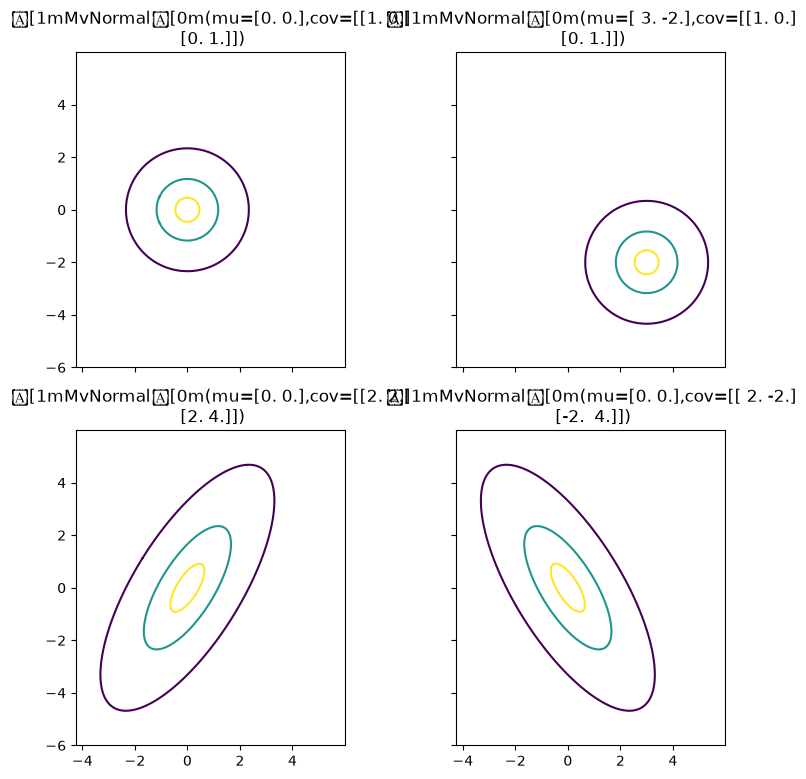

Cumulative Distribution Function (CDF)#
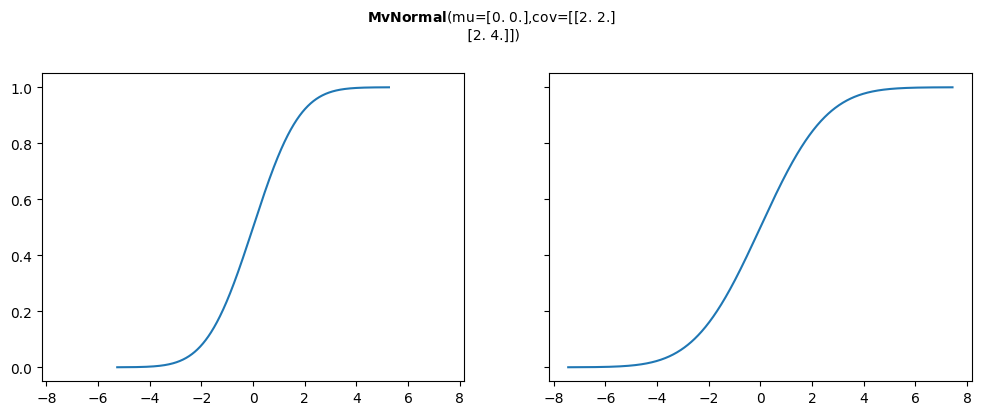
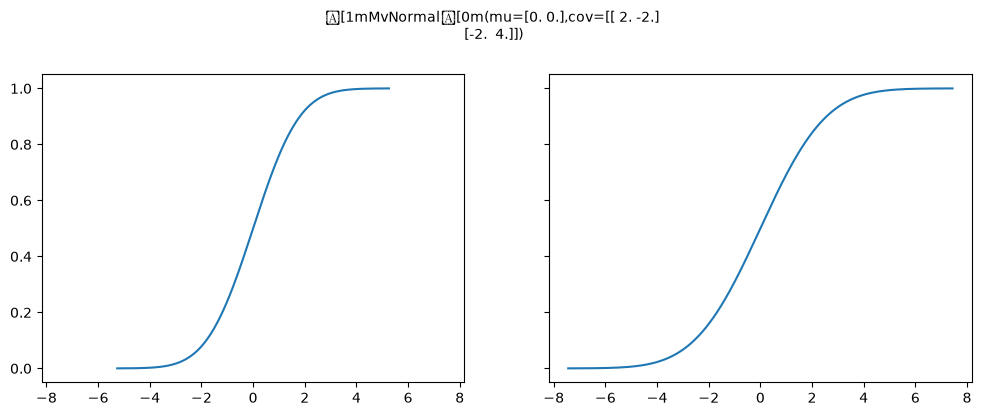
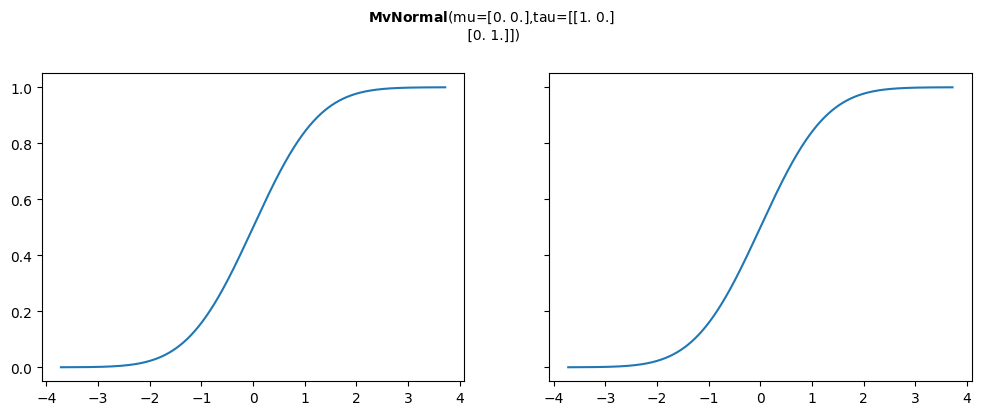
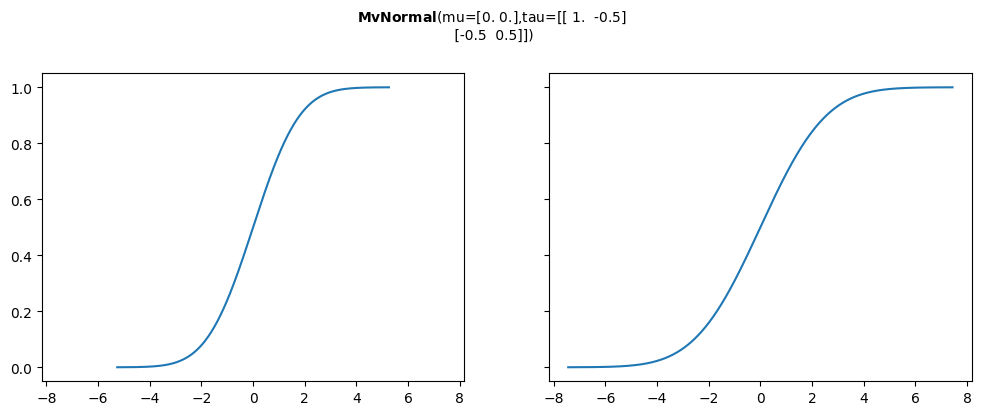
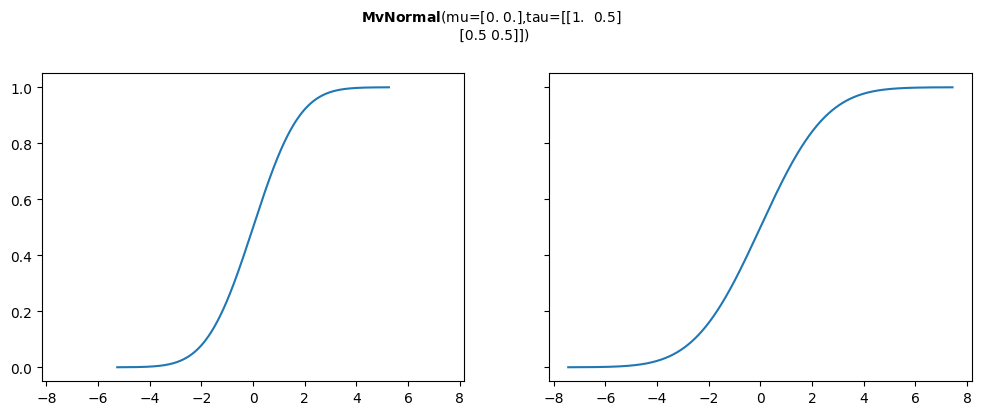
The multivariate normal joint CDF does not have a closed-form analytic solution in the general case, due to the complexity of integrating its density over \(\mathbb{R}^k\). However, each marginal distribution is a univariate normal distribution with a well-defined CDF that can be computed directly.


See also
Related Distributions:
Normal Distribution - The univariate normal distribution is a special case of the multivariate normal distribution with \(k=1\).