

Mixture Distribution#
This is not a distribution per se, but a modifier of univariate distributions.
A mixture distribution is a probability distribution that results from the combination of two or more univariate distributions. The resulting distribution is a weighted sum of the component distributions.
Mixture distributions are widely used whenever a single, simple distribution cannot adequately capture the complexity of a dataset. For example, in modeling the distribution of incomes across a population with distinct socioeconomic groups, mixtures can represent each subgroup’s unique income pattern.
Key properties and parameters#
Parameters:
dists: (list of Univariate PreliZ distributions) Components of the mixture. They should be all discrete or all continuous.weights: (list of floats) List of weights for each distribution. Weights must be larger or equal to 0 and their sum must be positive. If the weights do not sum up to 1, they will be normalized.
Probability Density Function (PDF)#
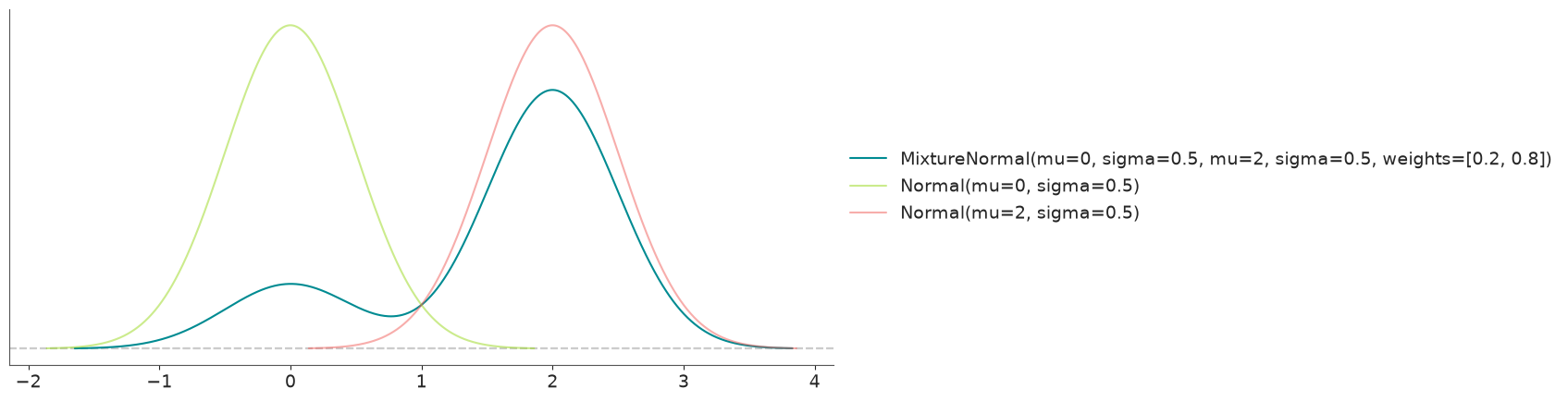
Given a list of base distributions with cumulative distribution functions (CDFs) and probability density/mass functions (PDFs/PMFs). The pdf of a Mixture distribution is:
where \(w_i\) is the weight of the \(i\)-th distribution and \(p_i(x)\) is the PDF/PMF of the \(i\)-th distribution.
Cumulative Distribution Function (CDF)#
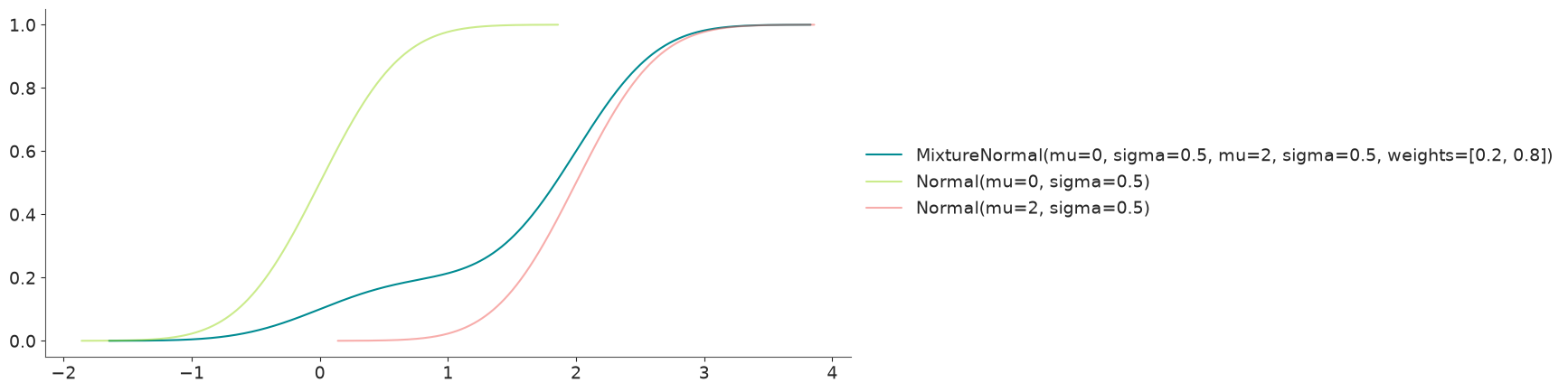
The cumulative distribution function (CDF) of a Mixture distribution is the sum of the CDFs of the component distributions.
where \(w_i\) is the weight of the \(i\)-th distribution and \(P_i(x)\) is the CDF of the \(i\)-th distribution.
See also
Related Distributions:
Hurdle - A modifier that combines a point mass at zero with a separate distribution for positive outcomes.
References#
Wikipedia - Mixture distribution