

Logit-Normal Distribution#
Univariate, Continuous, Asymmetric, Non-Negative, Heavy-tailed
The logit-normal distribution is a continuous probability distribution of a random variable whose logit (or log-odds) is normally distributed. Thus, if a random variable \(X\) follows a logit-normal distribution, then \( Y = \text{logit}(X) = \log\left(\frac{X}{1-X}\right)\) is normally distributed. It is defined for values of \(x\) between 0 and 1. It is characterized by two parameters: \(\mu\) and \(\sigma\), which are the mean and standard deviation of the logit-transformed variable, respectively, not the original variable.
The logit-normal distribution is useful in modeling proportions or ratios.
Key properties and parameters#
Support |
\(x \in (0, 1)\) |
Mean |
no analytical solution |
Variance |
no analytical solution |
Parameters:
\(\mu\) : (float) The mean of the logit-transformed variable.
\(\sigma\) : (float) The standard deviation of the logit-transformed variable.
\(\tau\) : (float) The precision of the logit-transformed variable, \(\tau = \frac{1}{\sigma^2}\).
Alternative parametrization
The logit-normal distribution can be parametrized in terms of \(\mu\) and \(\sigma\) or in terms of \(\mu\) and \(\tau\).
The link between the two parametrizations is given by:
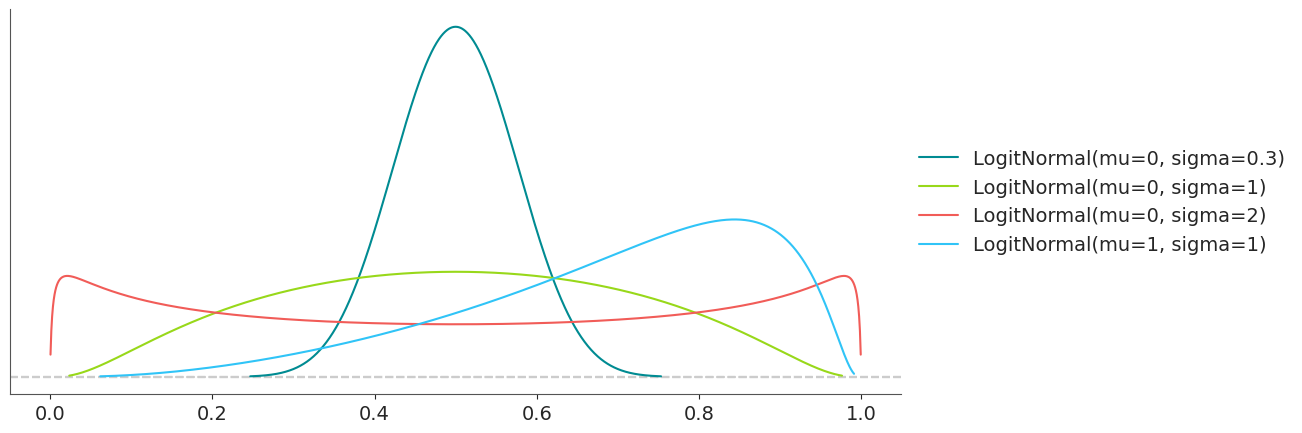
Probability Density Function (PDF)#

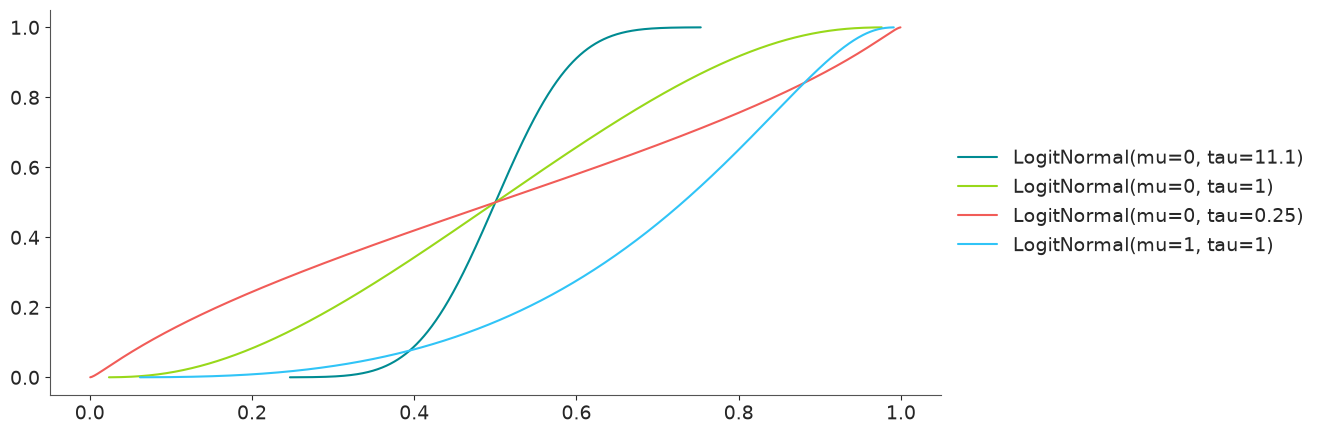
Cumulative Distribution Function (CDF)#
where erf is the error function.

See also
Related Distributions:
Normal Distribution - The logit-normal distribution is directly related to the normal distribution since if a variable is logit-normally distributed, its logit follows a normal distribution. This relationship is crucial for understanding the logit-normal’s properties and applications.