

Gumbel Distribution#
The Gumbel distribution, also known as the type-I Generalized Extreme Value (GEV) distribution, is a continuous probability distribution that describes the distribution of the maximum (or minimum) of a number of samples of various different random variables, particularly the exponential and normal distributions. It is characterized by two parameters: the location parameter \(\mu\) and the scale parameter \(\beta\).
The Gumbel distribution is commonly used in the fields of hydrology, meteorology, and environmental science to model extreme events such as floods, earthquakes, and wind speeds.
Key properties and parameters#
Support |
\(x \in (-\infty, \infty)\) |
Mean |
\(\mu + \beta \gamma\), where \(\gamma\) is the Euler-Mascheroni constant |
Variance |
\(\frac{\pi^2}{6} \beta^2\) |
Parameters:
\(\mu\) : (float) Location parameter.
\(\beta\) : (float) Scale parameter.
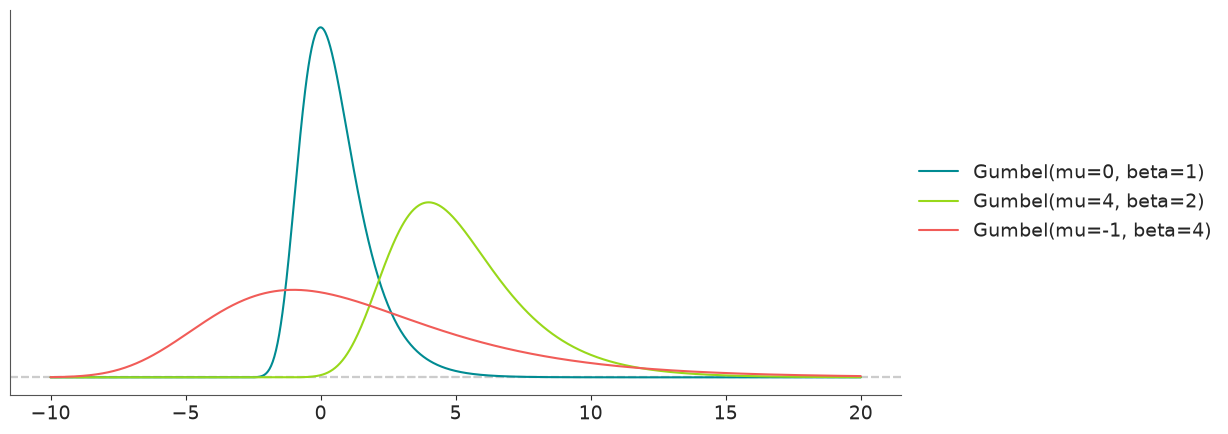
Probability Density Function (PDF)#
where \(z = \frac{x - \mu}{\beta}\).
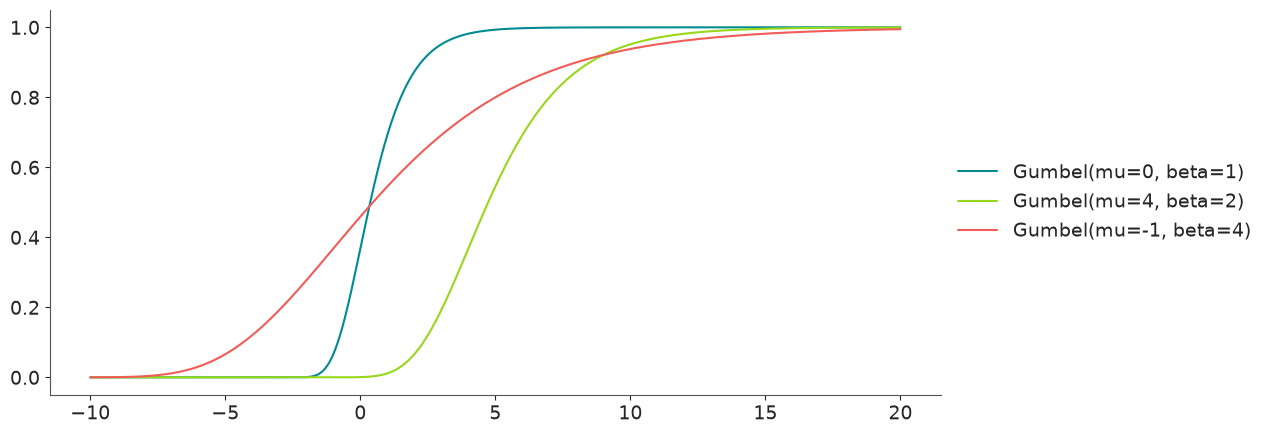
Cumulative Distribution Function (CDF)#
where \(z = \frac{x - \mu}{\beta}\).
See also
Related Distributions:
Weibull Distribution - If a random variable follows a Weibull distribution, the logarithm of the random variable follows a Gumbel distribution.
Exponential Distribution - The maximum of a number of exponentially distributed random variables follows a Gumbel distribution and the exponential distribution is a special case of the Weibull distribution.