

Discrete Uniform Distribution#
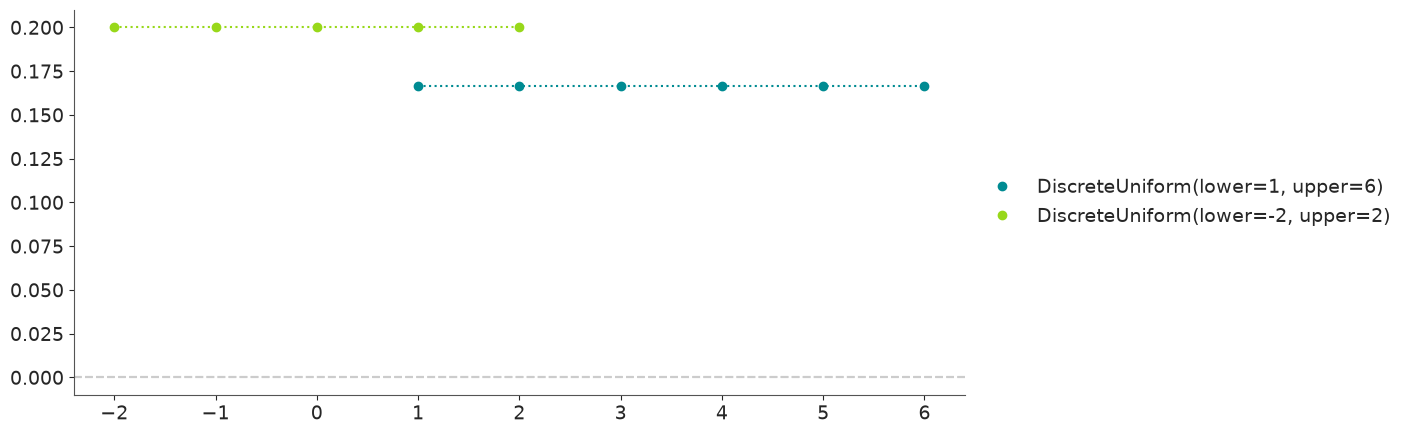
The Discrete Uniform distribution is a probability distribution where each integer value between lower and upper (inclusive) has the same probability. This distribution is characterized by two parameters: lower and upper, defining the range of integers.
A simple example of the Discrete Uniform distribution is rolling a fair six-sided die, where each face has an equal probability of 1/6.
Key properties and parameters#
Support |
\(x \in \{ \text{lower}, \text{lower} + 1, \ldots, \text{upper} \}\) |
Mean |
\(\dfrac{\text{lower} + \text{upper}}{2}\) |
Variance |
\(\dfrac{(\text{upper} - \text{lower} + 1)^2 - 1}{12}\) |
Parameters:
lower: (int) Lower bound of the distribution.upper: (int) Upper bound of the distribution, \(\text{upper} \geq \text{lower}\).
Probability Mass Function (PMF)#
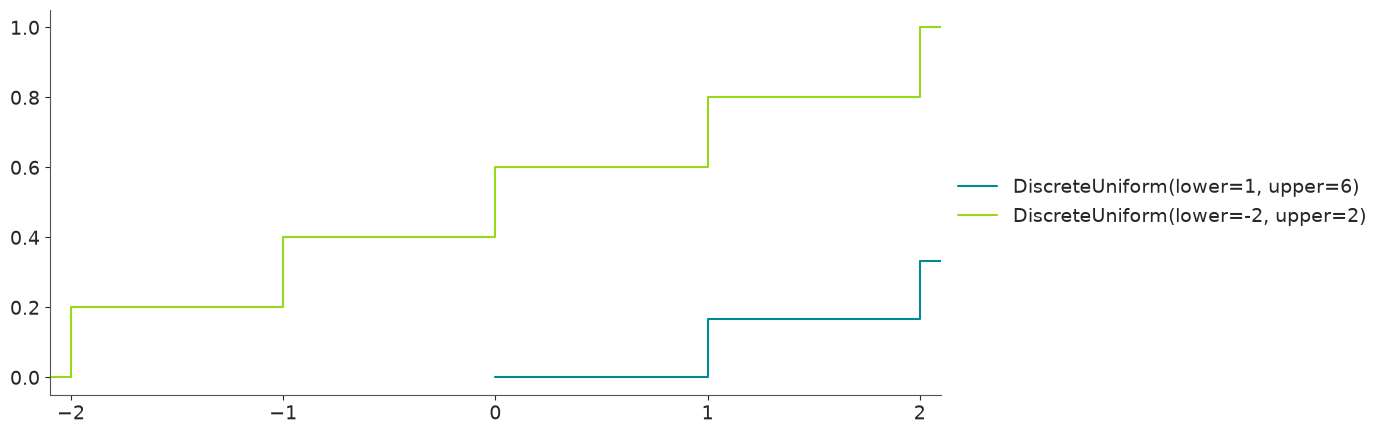
Cumulative Distribution Function (CDF)#
See also
Common Alternatives:
Categorical - The Discrete Uniform distribution is a special case of the Categorical distribution where all elements of \(p\) are equal.
Related Distributions:
Uniform - The continuous version of the Discrete Uniform distribution.